
Wilmette Resident Records Compared
A sound resident lookup asks a narrow question of each source. Cook County property records connect an address or parcel identification number to ownership and tax history, but ownership is not the same as occupancy. The Illinois voter tool checks one supplied identity and address combination. Court information can place a name in a case, yet a party may not be a Wilmette resident. Vital and genealogy indexes are strongest for family links and past events. Business and license files show a public role or credential, not a home address.
| Record | What It Confirms | Where to Search | Access |
|---|---|---|---|
| Property | Ownership, parcel, tax trail | Cook County Assessor | Free web search; counter or FOIA fallback |
| Voter registration | One supplied registration match | Illinois voter lookup | Free individual check; no public roster |
| Court docket | Party role, case type, dates, status | Cook County case search | Free summary; files and copies through clerk |
| Vital indexes | Historical birth, marriage, death links | Cook County Genealogy | Index search; copy rules and fees vary |
| State filings | Business role or professional credential | IDFPR license hub | Free public verification |
Start with the row tied most closely to the fact already known. An address can lead to a PIN and owner. A name plus birth date and ZIP can support the voter check when those details were lawfully supplied. A case number is better than a name alone for court work. For a deceased relative or an heir question, historical vital indexes and probate records are more useful than a current address search. Keep the original spelling and record date in the notes.
Looking Up Wilmette Court Names
The Circuit Court Clerk's online case information covers historical and active Cook County matters through a public summary search. Smart Search accepts record number or a name written as last, first middle. Advanced Search adds party type, case type, file-date range, case status, court location, judicial officer and judgment type. An exact case or record number is the cleanest route. Name searches should test a middle initial, a shortened first name, and known spelling variants.
| Result field | What to compare |
|---|---|
| Case number and style | Unique case key and the parties named in the caption |
| File date, type, status | Whether the matter fits the known time and subject |
| Party and attorney | The person's role, not proof of where that person lives |
| Events and hearings | Docket activity, dates, location, and disposition clues |
The summary is not the official case file. Sealed, juvenile, adoption, expunged, and other protected material will not be open. For an older or unclear matter, use a courthouse terminal, ask the division clerk, or contact the Cook County Circuit Court Archives. Archives holds pre-electronic material reaching back to 1871, and an offsite file transfer may take two to ten days.
Confirming Wilmette Voter Details
The state voter form is an individual verification tool, not a directory of Wilmette streets. Its first screen requires first name, last name, birth date, and a five-digit ZIP. A qualifying match then asks for street number and a street name selected from the choices shown for that ZIP. It does not offer open browsing by block, and it does not disclose ballot choices.
| Field | Format and role |
|---|---|
| First and Last Name | Required text fields; use the registered form of the name |
| Date of Birth | Required month, day, and year |
| Five Digit Zipcode | Exactly five digits at the first stage |
| Street Number and Street Name | Second-stage address confirmation, with street name selected from the list |
A failed match has several possible causes: spelling, date, ZIP, an inactive or canceled registration, or protected status. It does not prove that the person has no Wilmette connection. Bulk voter data follows separate eligibility, fee, redaction, and political-purpose limits under Illinois election law.
Note: Illinois does not use permanent party registration in the same way as closed-primary states, so a past primary choice is not current party identity.
Verify a Wilmette Resident Match
Namesakes are common enough that one hit should remain a lead. Build a small chain in which each source answers a different question. Preserve initials and spelling as shown. A Wilmette directory entry may include a spouse, trade note, phone, or old address that separates two people with the same name. A current deed may tie a name to property but still cannot prove who sleeps there now.
- Anchor the person to a known address, PIN, birth year, spouse, or family member. Use two identifiers whenever possible.
- Run the relevant official index. Compare dates, location, party role, and spelling rather than accepting a name-only hit.
- Cross-check a second custodian. Property, court, voter, and genealogy sources have distinct blind spots.
- Ask the keeper for the underlying file or a certified copy when legal proof is needed. Record the date and channel used.
- Docket
- The court's running list of filings, hearings, orders, and other case events.
- Index vs image
- An index points to a record and lists key fields. An image is the scanned document itself and may have a separate fee or access rule.
- Certified copy
- A copy authenticated by the office that holds the official record.
Wilmette Vital Index Lookup
Cook County and Illinois keep certificates under rules that are much tighter than ordinary public indexes. The county genealogy program opens qualifying records after set age thresholds: births at least 75 years old, marriages at least 50 years old, and deaths at least 20 years old. The IDPH genealogy route also states that death genealogy does not precede 1916. A certified copy requires the relationship or direct and tangible interest set by law, valid identification, and the custodian's form.
The successful manifest capture comes from the Cook County Genealogy search, where a free account opens separate birth, marriage, and death index panels.
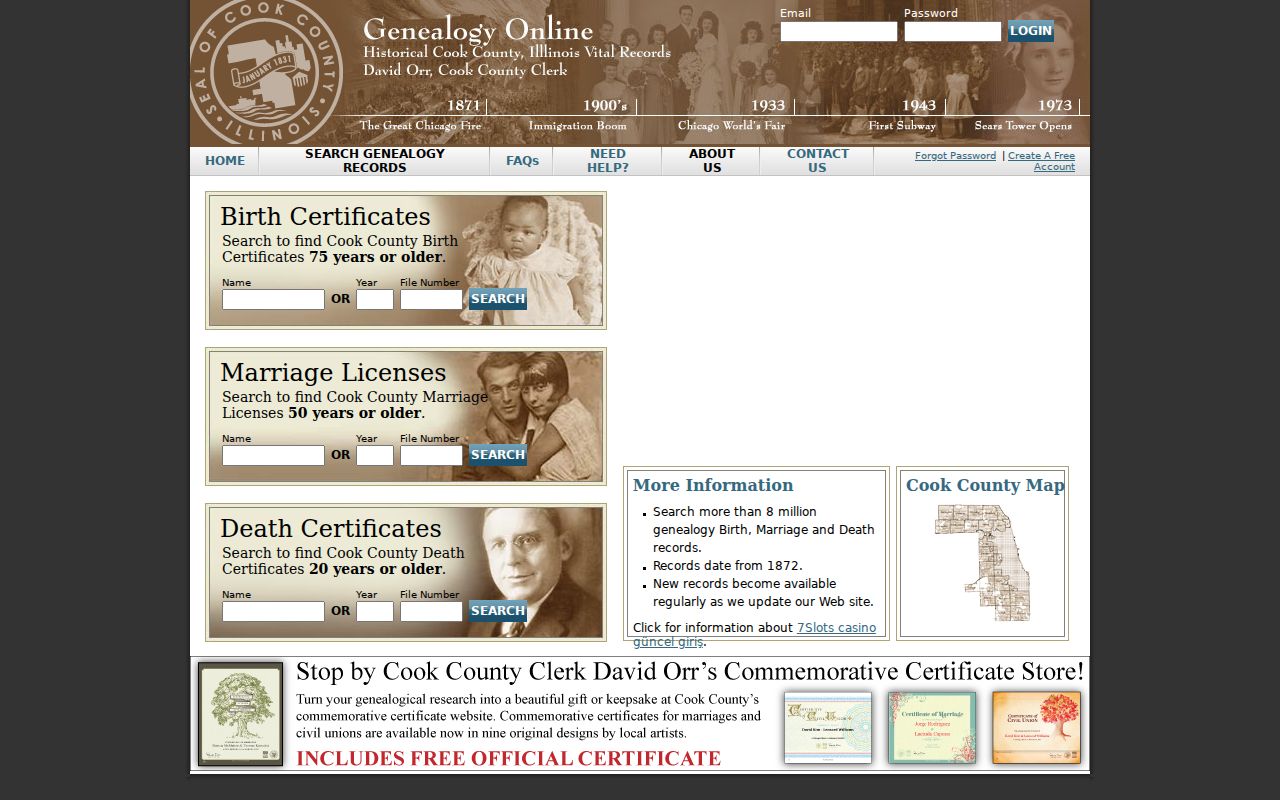
The screen illustrates the key distinction for a resident lookup: an index can identify a likely event, while the county request channel controls access to the underlying non-certified genealogy copy or certificate.
Tracing a Wilmette Person Back
For an old Wilmette connection, local history sources can solve the same-name problem better than a current roll. The Wilmette History Museum offers searchable directories for 1890, 1898, 1908, and 1946, plus local birth and death indexes. The Wilmette Public Library keeps telephone books, newspapers, obituary indexes, yearbooks, maps, oral histories, and appointment access to its Local History Room.
A visible typo in the museum's 1908 directory, “Carpneter (Sic),” is a useful warning. Search the spelling printed in the source as well as the corrected form. Occupation notes, a spouse name, a street abbreviation, or a telephone entry can keep two namesakes apart. Former classmates may also appear in New Trier yearbooks and alumni directories. For a modern verification after that historical lead, use the Wilmette city directory collections only as dated evidence, then check an official current custodian.
Wilmette Lookup Request Fallbacks
Online silence is not the end of a Wilmette resident lookup. A pre-electronic court case may sit with Archives. A deed recorded before the CRS web era may require the Clerk's office or older books. A vital event may be in a restricted file, while a local historical index still supplies a date or family link. Ask for the exact record category, date range, name variants, address, case number, or PIN.
The Village FOIA route covers municipal records such as permits and local files, not county court or vital certificates. Illinois FOIA generally calls for a response within five business days, subject to statutory extensions and other request rules. The first 50 standard black-and-white pages are free, with later pages generally charged at 15 cents each. Send court, voter, deed, and vital questions to their own custodians rather than one broad Village request.
Checking Wilmette Public Affiliations
A state filing can confirm a public role when the question concerns a business or professional link. The Illinois corporation and LLC search accepts an entity name, file number, registered agent, officer, or manager method. IDFPR verifies a regulated credential and status. The I-CASH search uses last or business name and first name, with optional city, ZIP, and property ID filters.
Each match needs careful wording. A registered-agent address is a filing contact, a professional record shows a license, and an unclaimed-property hit is only a claim lead. None proves a current Wilmette home. I-CASH requires identity and relationship proof in its claim flow, updates weekly, and returns approved property without charge.
Wilmette Resident Lookup Boundaries
Privacy rules are part of the record, not a gap to work around. Illinois vital law restricts certified certificates. Election rules redact and limit voter data. Sealed, juvenile, expunged, adoption, and other protected court material stays outside the public docket. Driver and vehicle information is restricted by state and federal law.
The Illinois Attorney General's Address Confidentiality Program gives qualifying survivors a substitute mailing address. Enrollment is free, lasts four years, and may be renewed or withdrawn. Agencies can redact or exclude the actual address, though the program cannot promise that all old public records disappear. Never try to reverse-engineer a protected address from voter, deed, or directory clues.
Lawful use. A Wilmette resident lookup is for lawful personal research. Never use a name, address, or record to stalk, harass, threaten, or harm anyone.
Send an error to the office that owns it: the Assessor for property-location data, Clerk Recordings for an index issue, the election authority for registration, or the court clerk for a docket problem. Include the PIN, case number, file date, or other record key and state the precise error. Keep both the request and response.